Picture this. A mid-career sales leader has a final-round interview on Friday. Each evening, he sits down with an AI interviewer and works through the questions he expects. He answers, stumbles, and tries a different angle: should he lead with the numbers he hit, or with the team he built? He does most of the talking. The interviewer mostly listens.
He knows this kind of practice only works through repetition. So he takes the same question three times a night, and runs the whole session again the next evening, until his answers sound like him at his best.
What he can’t see is the work behind the screen. Each of the interviewer’s questions takes a language model a second or two of computing to write. The interviewer’s face is another matter. If it is rendered in the cloud, a server in a data center draws it for every minute he practises, including the minutes he is talking and it is only listening. Over a week of evenings, those minutes add up.
He should be able to practise as often as he needs; that is what the app promises him. Yet when the face is rendered in the cloud, every attempt he makes carries a cost for the company behind it. The likely result is a cap on his minutes or a pack of credits, rationing precisely the repetition that would bring out his best.
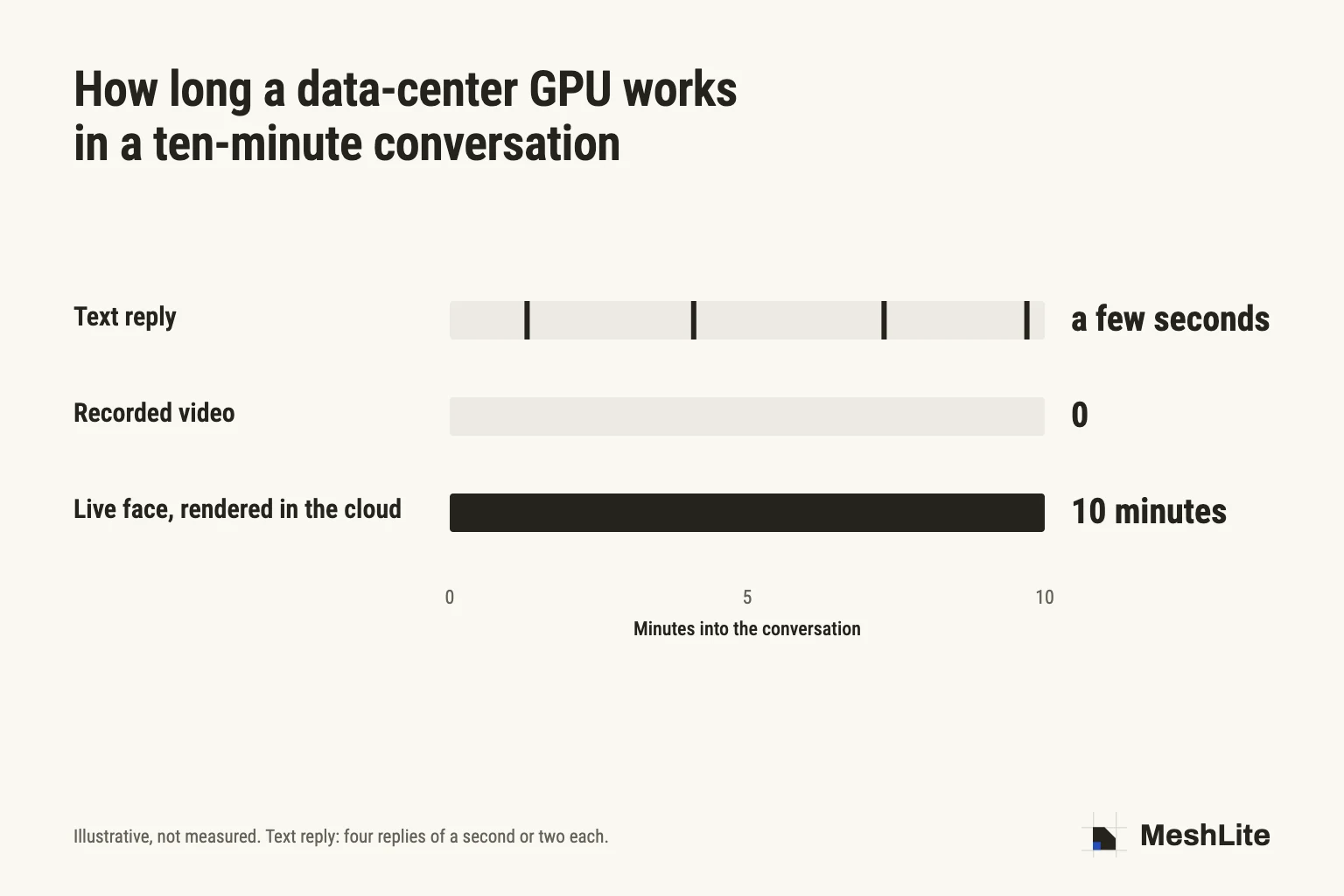
To see why the face costs so much more than the words, compare three ways his app could put a question to him: as text, as a recorded video, or through a live face.
A written question uses a GPU for a second or two
If the practice were text only, the language model would read the candidate’s answer and write the next question. That takes a GPU a second or two. Then the work is done, and the GPU is free for other people. The question stays on the screen while the candidate thinks about how to answer.
A video was made before anyone pressed play
A recorded video, say a career coach showing a strong answer, was filmed before anyone opened the app. It still has to be sent to the candidate’s laptop, and the laptop has to play it. But no server has to make the coach perform again for each viewer.
A live face is drawn while you watch
A live interviewer is different. It has to react to what this candidate just said, and its face has to move with that reaction. That face cannot be recorded in advance.
In most live avatar products today, the face is drawn in the cloud. A GPU in the provider’s data center draws 25 to 30 new images of the face every second and streams them to the candidate’s screen. It does this for the whole conversation, including the minutes when the candidate is answering and the face is only listening, nodding and blinking.
The question takes a second. The face takes the whole conversation.
Why it matters now
AI’s demand for computing is already straining electricity, water and hardware. New power connections take years, and the largest clouds say demand for AI capacity is ahead of what they can build. A face that keeps a GPU busy just to move adds to that demand, for every minute of every conversation. As more conversations get a face, that load grows with them.
Why you pay by the minute
Because the GPU is busy for as long as the conversation lasts, most providers charge by the minute. Off the Grid 2 adds up what that bill comes to over a month.
Drawing the face on the user’s device
A live face has to be drawn somewhere. Our stance is that it doesn’t have to be in a data center.
MeshLite draws it on the user’s own device. The expressions are prepared once, when the avatar is created, and his laptop places the right one on screen for each moment. We explain how in Lighter, not bigger.
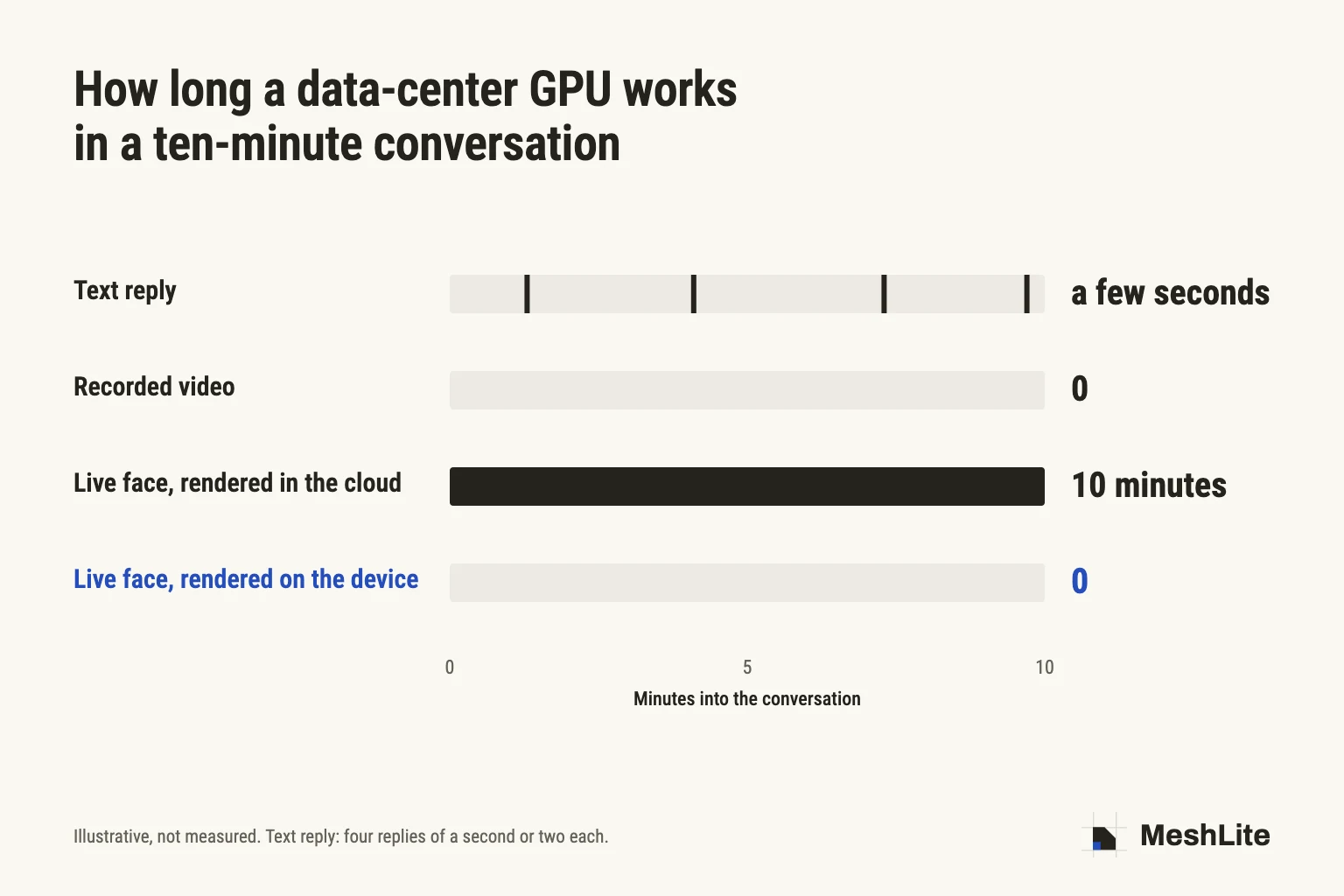
Back at the laptop, he takes the question a third time. This time, the face across from him is drawn on his own laptop.
Next
The face is one part of a bigger picture. Next, we look at why GPUs are scarce, what that has done to their rental price, and what a live face spends of that scarce capacity.
Sources: IEA, *Energy and AI* (2025) · LBNL, *Queued Up: 2026 Edition* · Microsoft, FY2026 Q4 earnings call, 29 July 2026 · Amazon, Q2 2026 earnings call, 30 July 2026.